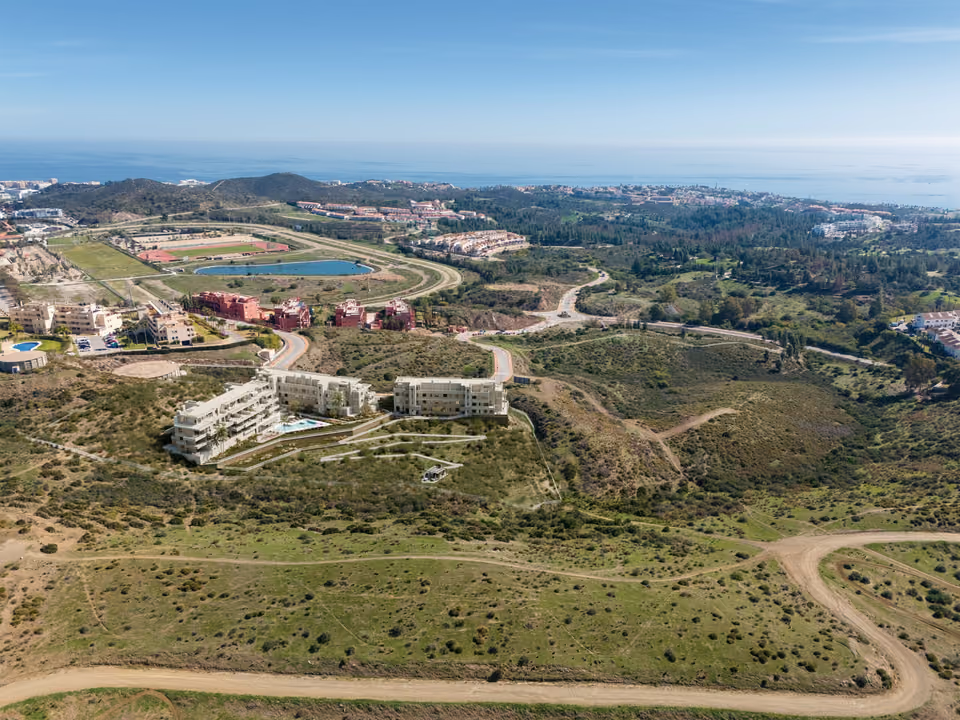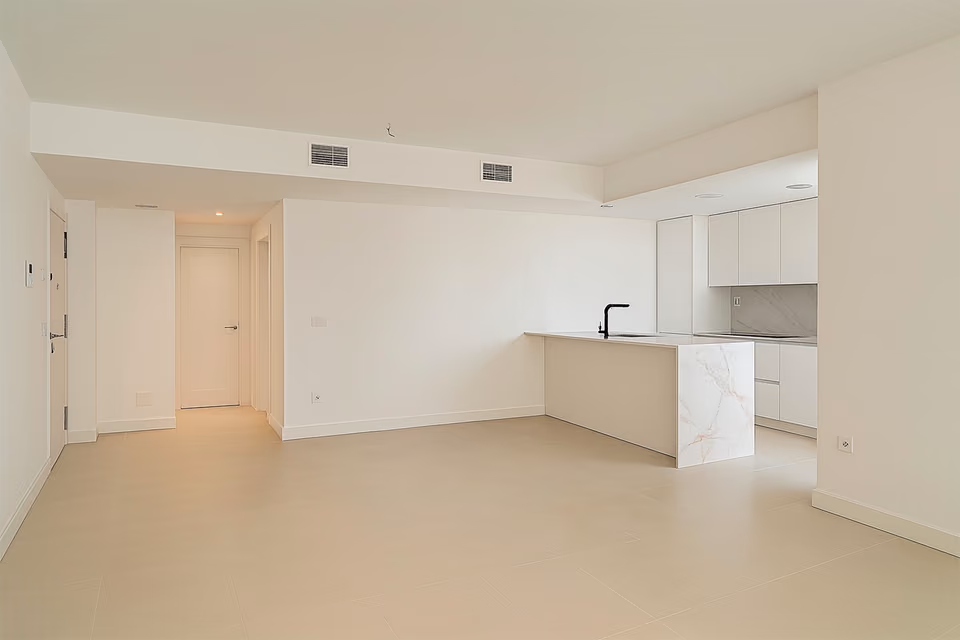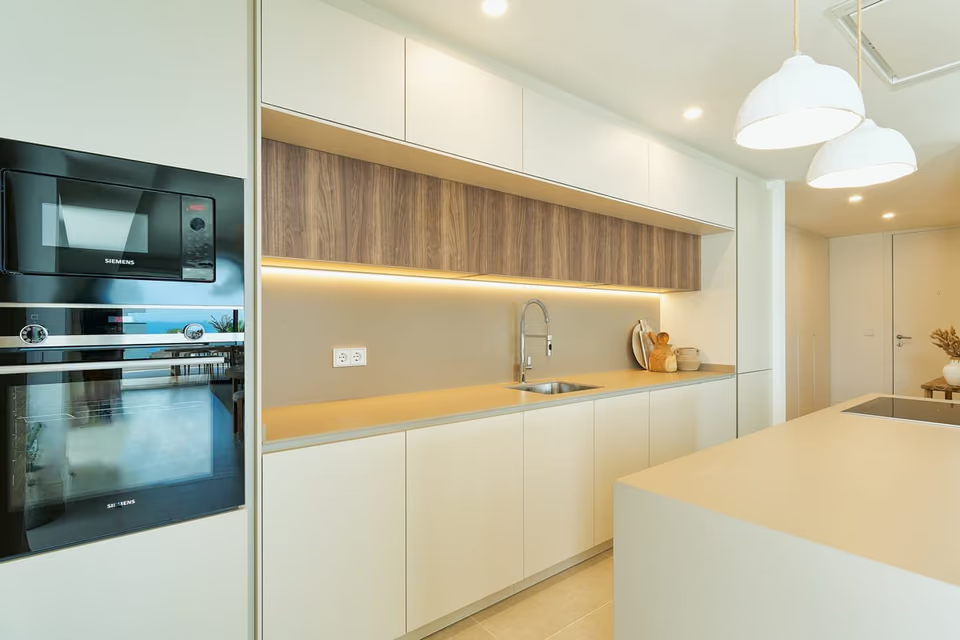
This guide sets out what a new build on the Costa del Sol includes as it stands in October 2026. It reads the specification lists of the 264 new developments I can show you, 254 of which have one on file, and counts what they actually contain. It covers what the building code requires of every new home, the heating, the kitchen and the finishes you can expect, the energy rating, the ten-year structural insurance, and the things that are usually extra. The rules are linked to the BOE and to the Ministry’s own building code site where they apply.
The specification list
A developer sets out what a new home is built from and fitted with in a specification, the memoria de calidades: a list, room by room, of the materials, the fittings and the installations. It is one of the documents you are entitled to see before you pay, as buying off plan in Spain explains, and your lawyer checks the contract against it.
Three things to know when you read one:
- “Or similar”. Fifty-eight of the 254 lists describe at least one item as a named make “or similar” or “or equivalent”, which lets the developer fit another make of the same standard.
- A furnished kitchen. A kitchen handed over furnished (cocina amueblada) means the units and the worktop are fitted. It does not mean furniture in the home.
- What the pictures show. Brochure images often include furniture and extras that are not in the price. At Málaga Towers the developer states that the furniture in the photographs is not part of it.
Fifty of the developments on file are finished, and the key-ready developments are the place to see a specification built.
What the building code requires
Every new home in Spain is built to the Código Técnico de la Edificación (CTE), the building code approved by Royal Decree 314/2006. It gives technical form to the basic requirements set by the building law, Ley 38/1999. A building has to be usable and accessible, and safe in its structure, in a fire and in use. It also has to be habitable, which the law defines as hygiene and health, protection from noise, and energy saving with thermal insulation. The code is built around six basic documents, for structural safety, fire safety, safe use and accessibility, energy saving, noise, and health.
Four of its rules explain most of what appears on a 2026 specification.
- Hot water from renewable energy. Section HE4 of the energy-saving document requires at least 70% of a new building’s hot water energy to come from renewable sources, or 60% where its demand is under 5,000 litres a day. The code counts aerothermal energy, the heat in the outside air, as renewable, and a heat pump qualifies once it reaches a set seasonal efficiency. On most of the lists below, a heat pump is how the building meets the rule.
- Solar panels on larger buildings. Section HE5 requires a new building of more than 1,000 m² to generate electricity from renewable sources. Thirty-one lists on file describe solar panels shared by the building, most of them supplying electricity to the communal areas.
- Cabling for car chargers. Section HE6 requires the car park of a new residential building to have cable routes for future charging points at every space. The route is built in. The charger is usually yours to add.
- Fresh air. Section HS3 of the health document requires every home to have a ventilation system, hybrid or mechanical, that brings air in through the living room and the bedrooms and draws it out through the kitchen and the bathrooms.
The same energy-saving document defines a nearly zero-energy building as one that meets its limits on energy use for new buildings, so a new home built to the current code counts as one.
Heating, cooling and hot water
More than four in five of the 254 lists name an aerothermal system or an air-source heat pump for the hot water or the heating. At MedBlue Marbella in Los Monteros the specification describes the system in one line: it “draws heat out of the outside air rather than burning gas”.
Air conditioning is on more than nine in ten lists, usually ducted through the ceilings. Four developments on file hand it over as ducting only, ready for the units to be fitted: Residencial Peñoncillo in Torrox, Calle Independencia 5 in Fuengirola, San Roque 13 in Vélez-Málaga and Baviera Golf at Caleta de Vélez. At Baviera Golf the machines can be fitted at extra cost before handover.
Underfloor heating runs through the home on 79 of the 254 lists, about three in ten, and only in the bathrooms on another 22. On seven it is limited to the penthouses or to a few rooms. Elsewhere it is an option. At Torre Biznaga in Fuengirola, underfloor heating in the bathrooms or through the whole home is offered at €9,000 in a two-bedroom home and €12,000 in a three-bedroom one.
Home automation, one system that runs the lights, the blinds and the climate from a screen or a phone, is fitted on about one in five lists. Others are wired for it. At Aura Higuerón in Fuengirola the cabling was run in during the build, so the lights, the blinds and the temperature can be put on one controller later without opening the walls.
The kitchen, the bathrooms and the finishes
Almost every list describes a fitted kitchen. Of the 182 that name the appliances one by one, 169 include the oven and the hob, and 142 name the fridge, the dishwasher and the washing machine. The exceptions are worth knowing.
- At Azure Homes in Los Pacos, Fuengirola, the dishwasher and the washer-dryer are on the extras list.
- At Almitak in Mijas the home is handed over with the space and the connections for a kitchen, and the units and appliances are sold as a package.
- At Baviera Golf the kitchen is handed over without units or appliances, and a fitted kitchen can be ordered at extra cost before handover.
- At Suite Mijas Phase Three a fridge, a washing machine and a dishwasher come with the home, which the two finished phases next to it do not include.
The rest of the list is more uniform. Porcelain floors appear on 181 of the 254 lists, fitted wardrobes on 185 and double glazing on 180, with a thermal break in the frames, an insulating strip that stops the cold passing through the metal, on 136. A security front door is listed on 168 and a video entry phone on 132. Sound insulation is described on 151, and the code sets limits on the noise that passes between homes.
Light fittings are worth checking too. At Abril Doña Julia in Casares, the interior light fittings are not included and are offered as a paid upgrade.
The energy rating
Seventy-seven of the 264 developments on file state an energy rating, and 76 of them are A or B: 54 are A, 21 are B and one is A or B depending on the phase. The one exception is rated C for energy use and B for emissions.
Most of those letters are design figures. Under Royal Decree 390/2021 a new building is certified twice, once from its project and again from the finished building, so the two can be compared. At Marina Golden Bay in Benalmádena, the B on the specification comes from the project calculations, and the final certificate is issued once the building is finished. On a home bought off plan, the certificate for the finished building is one of the papers to see at handover. What the letters measure, and what changes in 2030, is in the guide to energy certificates.
The ten-year insurance
Every new home a developer sells carries insurance against structural defects for ten years. Article 19 of Ley 38/1999 defines it as cover for material damage caused by defects in the foundations, supports, beams, floors, load-bearing walls or other structural elements that directly compromise the building’s strength and stability. The law’s second additional provision makes it compulsory for buildings that are mainly homes.
The developer takes out the policy, and the developer and every later buyer are the insured. The sum insured must be at least the full cost of building the works, professional fees included. A deed declaring a new building cannot be authorised or registered without it, under article 20. The shorter periods of cover, three years for the installations and one year for the finishes, are set out in the checks before you take the keys.
What is usually extra
The price on a developer’s list is the home before tax, and IVA at 10% and stamp duty at 1.2% come on top. Beyond that, these are the things the lists on file most often leave out or price separately.
Parking and a storeroom. About 150 of the 264 developments state that a parking space comes with every home, usually with a storeroom. A few price them separately:
| Development | Parking space | Storeroom |
|---|---|---|
| Lantana Residencial Boutique, Las Lagunas | €19,000 to €20,900, before IVA | €7,700, before IVA |
| Albatros XV, Nueva Andalucía | €30,000, plus IVA | From €15,000, plus IVA |
| Zenity Indigo, Estepona | Sold as a pair with the storeroom: €22,000 more on a home with two or three bedrooms, €38,000 more with four | In the pair |
On about twenty more, the price list does not say either way. At Célere Sunrise in Mijas there is no separate line for parking or a storeroom, so whether either comes with the home is a question for the developer.
Furniture. Most new homes are sold unfurnished. Several developers sell a pack: Sunny Golf in Estepona at €15,000 plus IVA, and Aloha Forest in Marbella and The Club Villas in Estepona separately from the price. At Los Porqueroles in San Pedro de Alcántara, the furniture in two of the villas is priced separately at €195,000.
Appliances. As above, the fridge, the dishwasher and the washing machine are not all named on about one in five of the lists that name the appliances.
The car charger. The cabling is standard, the charger often is not. South Residences in Fuengirola fits a charging point at every home, while at ERA Residence in Estepona a charger, a private hot tub and solar panels can each be added.
Private pools. At Blue Wave in Manilva, a private pool is offered as an extra on the homes that can take one.
How I handle it
I read the specification against the price list and the plans before you see a development. Then I ask the developer, in writing, what is in the price: the parking space, the storeroom, the appliances, the light fittings and anything drawn in the brochure. I add back whatever is missing, so two developments can be compared at their real cost, alongside the estimated community charge.
At handover I check the finished home against the same list, item by item. The new developments I can show you include those selling off plan, and new build or resale compares the two routes. To go through a specification you have been sent, book a call. Buying with me sets out how I work.
Common questions
What does a new build in Spain come with?
Are appliances included in a new build in Spain?
Is a parking space included in the price of a new build in Spain?
What energy rating does a new build in Spain have?
What is the ten-year insurance on a new build in Spain?
What is aerothermal heating?
What this relates to