

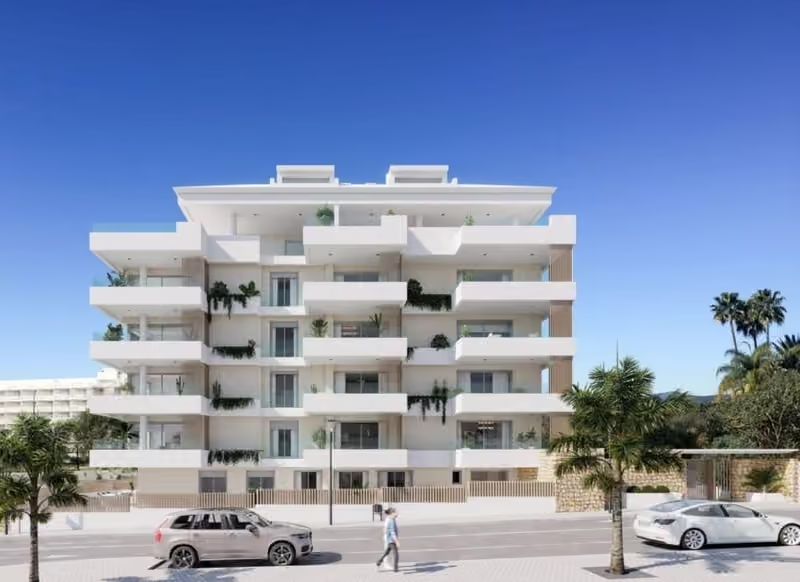
A resale and a new build on the Costa del Sol, new construction to an American buyer, are taxed differently, complete on different timescales and come with different protection. This guide sets the two side by side: the tax on each, worked on the same €350,000 example the cost guide uses, how the law protects your money when you buy off plan, what happens around completion, the guarantees that come with a new home, the checks before you take the keys, and who each suits.
The tax is the first difference
In Andalucía a resale carries transfer tax (ITP) at 7% of the price, set by article 41 of the region’s tax law. A new build bought from the developer does not pay ITP. It carries IVA at 10%, the rate for homes in article 91 of the Spanish VAT law, plus stamp duty (AJD) at 1.2% on the deed, set by article 49 of the Andalucían law. The reason a resale escapes IVA is that the same VAT law, at article 20, exempts second and later transfers of a building. So the two systems never overlap. A home is taxed one way or the other.
Worked on €350,000:
- Resale. ITP at 7% is €24,500. With your own lawyer, the notary, the registry and the admin, plan for 10 to 11% all in: €35,000 to €38,500.
- New build. IVA at 10% is €35,000 and AJD at 1.2% is €4,200, so €39,200 in tax before the same professional costs. Plan for 12 to 14% all in: €42,000 to €49,000.
The gap on this example is about €14,700 in tax. The rates are the same at every budget and for every buyer, wherever they are from, so the gap rises with the price. The budget guide runs both sums at €500,000, €800,000 and €1,100,000.
Buying off plan: how your money is protected
Most new builds on the coast are sold before they are finished, and you pay in stages while the building goes up. Spanish law is clear on what happens to that money. The first additional provision of the building law, Ley 38/1999, as rewritten by Ley 20/2015 with effect from 1 January 2016, requires a developer taking payments before completion to:
- guarantee the return of every sum you pay, plus the legal interest, through an insurance contract (seguro de caución) or a bank guarantee (aval solidario) from a credit institution, from the moment the building licence is obtained
- keep your money in a separate account, used only for the costs of the build
- return the money with interest if the build does not start, or does not finish, by the date agreed for handing over the home
The guarantee runs until the town hall issues the licence of first occupation or an equivalent document. The UK government’s guidance on buying in Spain puts it in one line: developers of off-plan properties are legally obliged to secure all deposits with a bank guarantee. The practical step is simple. Before you pay a reserva or a stage payment, your lawyer confirms the guarantee has been issued, that it names you, and that it identifies the specific home you are buying. A developer who has the guarantee in place hands it over without fuss.
Timing and certainty
A resale completes on a known timetable. A cash purchase normally runs six to twelve weeks from accepted offer to the deed, and eight to sixteen with a Spanish mortgage. I set the stages out in the Spanish buying process.
A new build completes when the building is finished and licensed. The contract gives a delivery date, and the guarantee described above is what stands behind it. Build programmes do move, so the contract should say what happens if the date is missed, and your lawyer reads that clause before you sign. The document that matters at the end is the licencia de primera ocupación, issued by the town hall, which confirms the finished building matches its licence and can be occupied. The UK government’s guidance says to make sure you have it, and I would not complete without it.
On a resale the same licence should already exist for the building, and it is one of the papers your lawyer checks along with title, debts and the community accounts before the arras.
The guarantees that come with a new home
Spanish building law gives a new home three periods of cover, set in article 17 of Ley 38/1999:
- Ten years for damage caused by defects in the foundations, supports, beams, floors, load-bearing walls and other structural elements
- Three years for defects in the building elements or installations that stop the home meeting the habitability requirements
- One year for finishes, which is the builder’s responsibility
Article 19 of the same law requires the developer to hold ten-year insurance on the structural cover, the seguro decenal. On a resale less than ten years old, what remains of those periods passes with the building. On an older resale the cover has run out, and a survey takes its place. The UK government’s guidance suggests a chartered surveyor, and on an older home I agree.
The checks before you take the keys
On a new build, the last step before completion is a walk through the finished home with a written list. Doors, windows and their seals. Every tap, drain and socket. The air conditioning and hot water. Tiling, paint, silicone and the terrace drainage. That what was built matches the plans and the specification you bought from, down to the kitchen and the bathroom fittings. Anything short goes on the list in writing, and the developer puts it right. Alongside the walk, your lawyer confirms the licence of first occupation, the utility connections, the ten-year insurance policy and that the community of owners has been set up.
On a resale, the checks happen earlier, before the arras: title, debts, the building’s licences and that any extension or pool was built legally, the community accounts, and a survey where the age of the building calls for one. The walk before completion is shorter and confirms the home is as you saw it and empty of anything that should have gone.
Who each suits
A resale suits a buyer who wants a particular street or an established part of town, who wants to see the actual rooms and the actual view, and who wants to complete in weeks. It also suits a buyer who would rather spend the tax saving on updating a home to their own taste. Much of the coast’s best-placed housing is resale, because the towns were built before the current wave of development.
A new build suits a buyer who wants a home built to current standards, a modern layout, and ten years of structural cover from day one. It suits someone who is not in a hurry, who is happy to buy from plans and a show home, and who has the extra tax in the budget. Newer developments sit where land was available, so the trade is often a newer home for a less central position.
Neither is the better answer in general. One of them is the better answer for you.
How I handle it
My approach is the same on both: proper research on the property and its area, a straight assessment of what it is genuinely worth, and careful negotiation on your behalf. On a new build that means reading the developer’s guarantee and contract with your lawyer before you pay, tracking the build, and walking the finished home with you before completion. On a resale it means the checks before the arras and a survey where one is warranted. What I can show you at the moment, with the starting price and the stage each build has reached, is set out in new developments on the Costa del Sol. Both are part of the buying service, and the numbers above are the first thing we go through on a call.
The new builds I can show you are listed town by town, with their starting prices: Estepona, Marbella, Benahavís and Istán, Mijas and La Cala, Fuengirola, Benalmádena and Torremolinos, Casares and Manilva and Málaga and the east coast.
Tax rates are the 2026 Andalucía rates and the building-law provisions are as consolidated on boe.es, last checked 13 September 2026 against the laws linked above. General guidance, not legal advice. Always instruct an independent Spanish abogado before you sign.
Common questions
Is it cheaper to buy a new build or a resale in Spain?
Is my money protected if I buy off plan in Spain?
What is the licence of first occupation?
What guarantee comes with a new build in Spain?
Do I pay IVA on a resale in Spain?
Is a new build a good idea on the Costa del Sol?
What this relates to
The same subject, for buyers abroad
Pages written for buyers in other countries, in their own language, covering what changes for them.


