This guide covers what “primera línea” and “primera línea de playa” mean in a Costa del Sol listing, what Spain’s coastal law says about the land between the buildings and the sea, what that means for a building close to the sand, and what the frontline new developments on file ask, as it stands in October 2026. The law comes from the Official State Gazette (BOE), the boundary surveys from the Ministry for the Ecological Transition, and the prices from the developers’ own lists.
What “primera línea” means in a listing
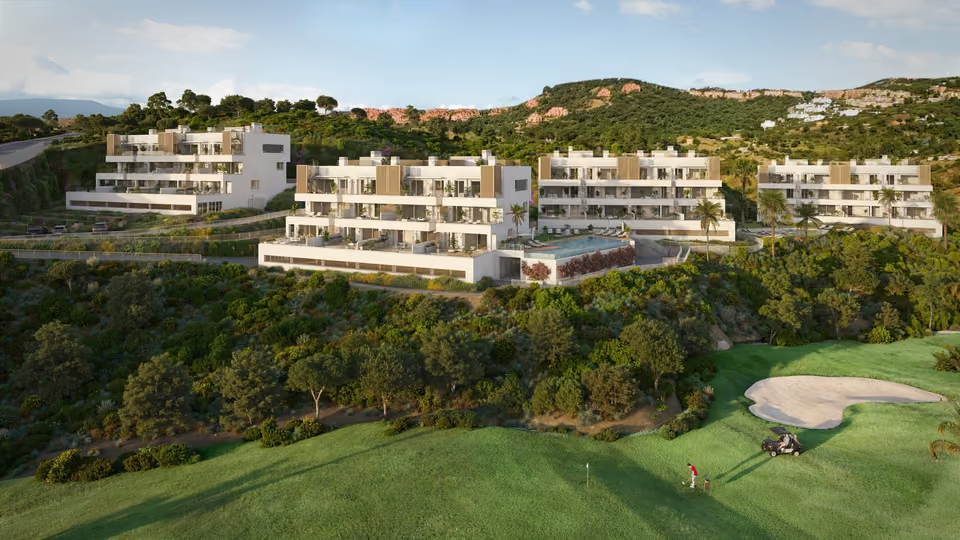
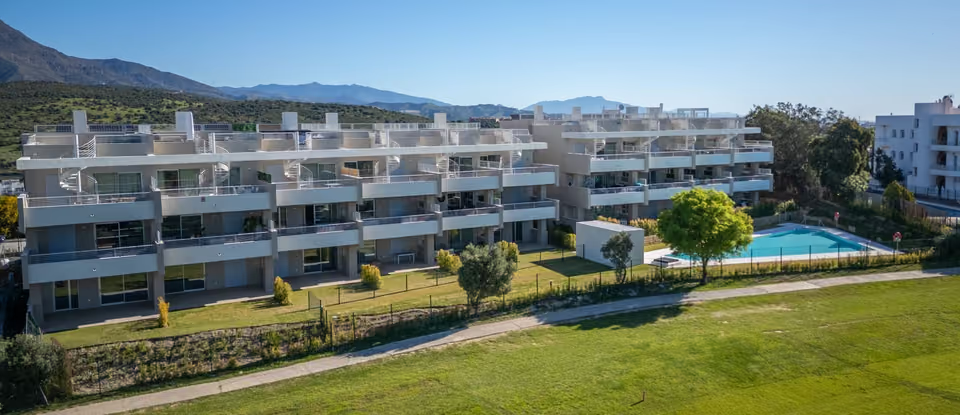
Primera línea means “first line”. In a listing it describes a home in the first row of buildings facing the sea. Primera línea de playa narrows it to a beach, with nothing built between the home and the sand. Segunda línea is the row behind. Listings use the same word for golf, where a home “frontline” to a course sits on its edge, as two of the villas under Luxury property do.
These are descriptions, not legal categories. The coastal law never uses the phrase. It works in metres from the shore, as the next section sets out. So when a listing says primera línea, the useful questions are plain ones. What lies between the home and the water: a garden, a promenade, a road, a beach bar? How many metres is it to the sand? Do you see the sea from the living room, or only from the corner of the terrace?
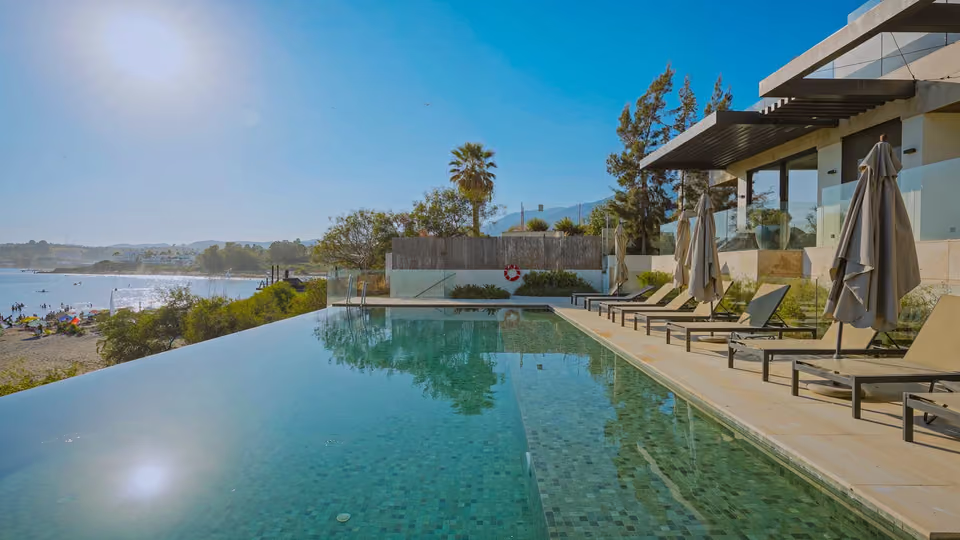
The developers on file describe their seafront buildings in different ways. Atelier 4 in Estepona stands on the front line of Playa del Cristo, with an infinity pool that looks straight over the sand. Dunique Marbella in Las Chapas is on a plot that runs down to the dunes of El Barronal. Alborán Bora in Torremolinos faces the beach at Los Álamos, where Avenida Mar de Alborán meets the promenade, four minutes on foot from the sand. All three are close to the sea. Each has a different stretch of ground between the home and the water.
What the coastal law says
The coast is governed by the Ley 22/1988 de Costas, in force since 29 July 1988, as reformed by Ley 2/2013, in force since 31 May 2013. It divides the land behind the sea into a public strip and a set of zones with rules of their own.
| Zone | Width | What it means for a home |
|---|---|---|
| Public domain | The shore, the beach and the dunes that keep it stable | Owned by the State. A building on it holds a concession, not a title |
| Transit strip (servidumbre de tránsito) | 6 metres inland from the inner edge of the shore | Kept clear for people on foot and for rescue vehicles. A promenade can run along it |
| Protection zone (servidumbre de protección) | 100 metres, or 20 metres on land that was urban in 1988 | No new homes. Existing ones can be repaired, not enlarged |
| Zone of influence | At least 500 metres | The town plan must avoid walls of buildings |
The public domain. The shore, the beaches and the dunes needed to keep a beach stable belong to the State (article 3). Where the public domain ends is fixed by an official boundary survey, the deslinde. Once it is approved, it declares the State’s ownership, and no entry in the Land Registry can prevail against it (article 13). Homes are expressly excluded from the public domain (article 32), and no one owns a private beach in Spain.
The protection zone. A strip 100 metres deep, measured inland from the inner edge of the shore, which the State can widen by up to another 100 metres (article 23). On land that was already classified as urban when the law came into force, it is 20 metres (third transitional provision). Buildings for homes are prohibited inside it (article 25), with one narrow exception in towns, where the town plan can allow new homes to complete an existing row of seafront buildings on strict conditions.
The transit strip. The first 6 metres inland must be kept permanently clear for people on foot and for rescue and surveillance vehicles, and the law allows a promenade to be built along it (article 27).
Access to the sea. In towns, the town plan must provide public accesses to the beach no more than 500 metres apart for cars and 200 metres apart on foot, and no works may cut off an access without an equivalent one in its place (article 28).
The zone of influence. At least 500 metres inland, where the town plan must avoid walls of buildings and concentrations of volume (article 30).
What it means for a building near the sand
A building that was lawfully built before 29 July 1988 and now falls inside one of these zones can stay. What the law allows on it is set out in its fourth transitional provision, as rewritten in 2013.
- Inside the protection zone, the owners can carry out repair, improvement, consolidation and modernisation, provided the work adds no volume, height or floor area. If the building comes down, in whole or in part, whatever replaces it must comply fully with the law, which leaves no room for new homes inside the zone outside that narrow exception. A frontline block can be kept up to date. It cannot be rebuilt larger.
- Since 2013, those works must also improve the building’s energy rating, by two letters or to a B, and save water. Before the town hall authorises them, the owner files a responsible declaration, a signed statement that the work meets these terms.
- On the transit strip, the same works need a favourable report from the State first, which is treated as given if it has not arrived within two months.
- On the public domain itself, a building stays while its concession lasts, with the same limits on works. The 2013 reform allows existing concessions to be extended, for up to 75 years.
The line itself can move. The law requires a boundary to be revised when the shape of the public domain changes (article 13 bis). Land that a revision brings into the public domain becomes a 75-year concession for its owner, with no fee to pay, and a building that a revision brings into the protection zone keeps the right to be repaired and modernised, but not enlarged.
On this coast the ministry is redrawing old lines stretch by stretch. Its deslinde page for Málaga lists approved boundaries and corrections from Manilva to Nerja. Estepona alone has several, one of them a change to the width of the protection zone. A 2022 project for Torrox sets out the reason: several stretches of the Málaga coast were surveyed under the law and with the technical means of their day, and their maps have become out of date and incomplete. When a survey starts, the Land Registry adds a note to each property it may affect, warning that it could pass into the public domain or the protection zone (article 12). That note is one of the things a lawyer looks for.
The checks before you buy on the front line
The usual checks apply to any purchase, and the legal checks before you buy in Spain sets them out, from the registry extract to the community’s debts. A frontline home adds four of its own.
- Where the lines fall. Whether the home sits on the public domain, the transit strip or the protection zone, and whether the stretch has a boundary approved or under revision. Andalucía’s planning law gives anyone the right to be told the planning rules for a specific building and to ask the town hall for a written report on its position, under article 10.
- The building’s papers. The building licence and its date, the licence of first occupation and, for anything on the public domain, the concession and when it ends. The first occupation licence and AFO guide covers the planning papers.
- The building’s condition and the community’s plans. A block in the protection zone can be repaired but not replaced like for like, so its upkeep matters more than usual. The minutes of the owners’ meetings show the works ahead and how they will be paid for, and community fees in Spain explains what to read in them.
- The view, one row back. On the front line, what lies in front is the public beach, where no homes can be built. One row back, the view depends on the town plan, and the guide to sea views shows how to read it.
What frontline homes cost
The idealista figures the site uses are averages for whole towns and districts. They mix seafront homes with homes far from the sand, so on their own they cannot price the front line. In Marbella, Nagüeles and the Golden Mile averaged €8,336 a square metre on idealista’s asking prices in August 2026, the highest of the town’s seven districts, against €5,956 for Marbella as a whole. That district figure takes in hillside homes as well as beachfront ones.
The frontline and beachside new developments on file give a closer reading. These are the starting prices before VAT, what the cheapest home works out at for each square metre built, and idealista’s 2026 asking-price average for the town, or for the district in Marbella’s case (August 2026).
| Development | Where | The sand, in the developer’s words | From | Cheapest home per m² | Average per m² |
|---|---|---|---|---|---|
| Atelier 4 | Playa del Cristo, Estepona | On the front line | €3,101,500 | €27,209 | €4,307, Estepona |
| Dunique Marbella | Las Chapas, Marbella | On the beach, beside the dunes | €5,200,000 | €10,744 | €5,407, Las Chapas · El Rosario |
| Málaga Towers | Carretera de Cádiz, Málaga | 4 minutes on foot to Misericordia beach | €4,408,000 | €10,673 | €3,937, Málaga |
| Nubay | La Chullera, Manilva | 100 metres | €1,325,000 | €9,947 | None on file |
| Alborán Bora | Los Álamos, Torremolinos | 4 minutes on foot | €778,500 | €8,462 | €4,229, Torremolinos |
| Vesta Mare | La Duquesa, Manilva | On the seafront | €435,000 | €5,284 | None on file |
Two things keep the comparison honest. A developer’s built area includes a share of the shared parts, which a resale listing usually leaves out. And the town averages are made up mostly of older homes, so part of each gap is the new building rather than the sand. The spread is still wide, from about double the local figure to more than six times it. VAT at 10% and stamp duty at 1.2% come on top of every price, as the cost of buying sets out.
Most new homes near the sea are a few minutes back from it rather than on it. The full list, with each developer’s walking time, is on new developments within a short walk of the beach. At the top of the range, a frontline villa or penthouse also raises the wealth tax question, and wealth tax in Andalucía sets out how the region treats a home of that value.
Letting a home by the beach
If the plan is to let the home to holidaymakers, three permissions decide it, and none of them comes with the view. The home needs a registration in the Junta de Andalucía’s tourist register. The town hall’s position at that address matters as much, and the tourist licence guide sets out the standards and where new registrations are limited in 2026. And the community of owners has a vote. Since 3 April 2025 an owner who wants to start a holiday let needs the community’s express prior approval, by three fifths of the owners holding three fifths of the shares, under articles 7.3 and 17.12 of the law on communities of owners. An owner already letting under the tourist rules before that date can carry on.
That makes a frontline apartment already registered, with the community’s position on record, a different purchase from the same apartment without either. I establish both before price is discussed.
How I handle it
On a frontline purchase I start with the lines rather than the view. Before you travel, I find out where the public domain, the transit strip and the protection zone fall at the address, whether the stretch is being surveyed again, and what that means for the building and for any works it will need.
Then I read the community’s minutes for the works ahead, compare the asking price with recent sales on the same stretch of coast, and give you a straight view of what the home is worth. When you decide to go ahead, I negotiate the price and the terms on your behalf and work alongside your independent lawyer through the checks and the signing. If a home by the sand is what you are after, book a call and we can start with the stretches that fit. Buying with me sets out how I work.
Common questions
What does primera línea de playa mean?
Can a new home be built on the front line of the beach in Spain?
Can I renovate an older frontline apartment inside the coastal protection zone?
How much more does a frontline home cost on the Costa del Sol?
Who owns the beach in front of a frontline home?
Can I let a frontline apartment to holidaymakers?
What this relates to