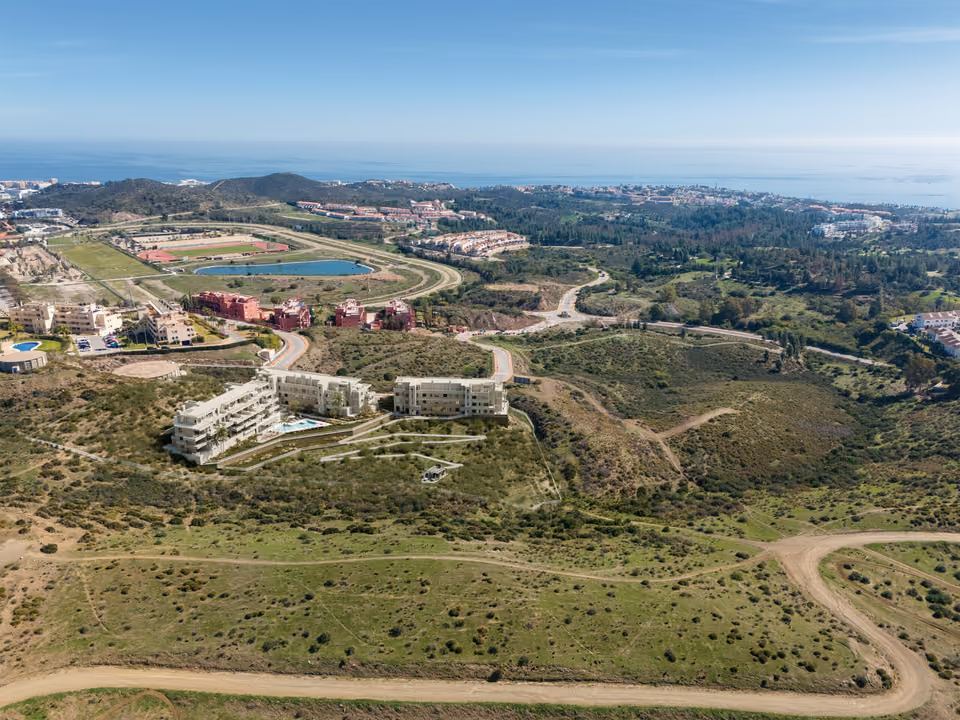
What it takes to buy a building plot on the Costa del Sol and build a villa on it, under the rules in force in October 2026. Andalucía’s land law changed in December 2021, and most of what decides whether you can build, what you can build and when follows from it. This guide sets out the two classes of land and what each allows, the checks on a plot before you commit, the taxes on the purchase, the project and the licence, what the building costs once the taxes and fees are added, the order of events from purchase to keys, and where the plots are. Each rule is taken from the law, the regulation or the official tariff, linked where it appears.
Urban land and rustic land
Andalucía’s land law, Ley 7/2021, known by its Spanish initials as LISTA, puts all land into two classes, urban and rustic. The third class of the old law, land set aside for future building, no longer exists.
Urban land is land inside the built-up fabric of a town that meets one of three tests in article 13. It was urbanised under a plan, or it has road access and connections to water, sewerage and electricity, or at least two-thirds of the area that can be built on already is.
Within urban land, the plot to look for is a solar, a finished building plot. Article 13 defines it as an urban plot with the services its plan requires and, at the minimum, a paved road to it, street lighting along its frontage, and water, sewerage and electricity of enough capacity. Article 18 gives the right to build only once a plot is a solar. Where a service is missing, the owner has to complete it first.
There is one way to build while the last services are still going in. Under article 203 of the regulation that implements the law, the town hall can license a house alongside the remaining works if the redrawing of the plots is final, the urbanisation project is approved, a guarantee covers the works still to do, and the owner undertakes not to live in the house until they are finished. Nobody can move in until the town hall has taken the works over.
Land in a sector that has not yet been urbanised is a different purchase. The urbanisation costs are a charge on the land itself under article 95, and no building licence can be granted until the formal redrawing of the plots, the reparcelación, is final, under article 99. Buying in a sector like that is buying into a development process, and the timetable belongs to that process.
Building a house on rustic land
Rustic land is everything that is not urban, in four categories from specially protected land to common rustic land. Article 20 of the law prohibits dividing it up for urban-style building, or doing anything that would create a new settlement. A house on rustic land is possible on two routes, and both are narrow.
A house tied to a farm. Article 21 allows a home that is necessary for a working agricultural holding, as the main home of the people who run it. A note in the Land Registry links the house to the farm and makes the two indivisible.
A free-standing house. Article 22 allows a house with no link to any farm as an extraordinary use, if it creates no settlement. Article 31 of the regulation sets the conditions:
- one house, on a plot of at least 2.5 hectares, or 5 hectares on forest land, that can hold a circle of 50 metres radius
- more than 100 metres from any other home
- a footprint of no more than 1% of the plot, and a built area of no more than 1%
- two storeys at most, set 25 metres back from the boundaries
- its own water and power supply, preferably renewable, with a connection to the networks only by exception
The town hall gives a prior authorisation before the licence, after at least a month of public consultation, within six months. Silence is a refusal. The owner then pays a one-off compensatory charge of 15% of the construction budget, under article 22.5. The Constitutional Court’s judgment 25/2024 struck out a separate clause of article 22 and left this route in place.
On the minimum plot of 2.5 hectares, a 1% footprint is 250 square metres. For a buyer who wants a villa within reach of the coast, the plot to look for is an urban one.
The checks on a plot before you commit
Your own lawyer runs the legal checks set out in the legal checks guide. A plot raises questions that a finished home does not. These are the ones that decide what you can build.
Ownership and charges. The nota simple from the Land Registry shows who owns the plot and any mortgages, charges and restrictions on it. Article 222 of the Mortgage Law says it is for information only. The Catastro record adds the mapped boundary, the area and the reference value, and the cadastral reference has to appear in the deed.
The planning certificate. On request, the town hall issues a written statement of the planning rules for a plot, the cédula urbanística, under article 3 of the regulation. It states the plans that apply, the class of the land, the main building parameters, whether the plot is a solar or what it lacks, and any enforcement proceedings. The town hall has one month to issue it. It is for information rather than binding, and it holds for six months at most while the plan stays the same.
The plan’s numbers. The local plan sets what a plot can carry: the minimum plot size, the floor area that can be built, the share of the plot the house can cover, the height and the distance to the boundaries. As an example, the Benahavís plan of 1997, back in force after the regional high court annulled its 2018 revision, sets these figures for its zone of detached houses:
- minimum plot: 800 m²
- floor area: 0.5 m² for every m² of plot
- coverage: 30% of the plot
- height: two storeys and 7 metres
- distance to the boundaries: 3 metres
On a 2,000 m² plot in that zone, that allows 1,000 m² of floor area, with a footprint of up to 600 m². Gated estates often have their own detailed plan with their own figures. La Zagaleta, for one, has its own plan. The numbers always come from the plan that covers the plot itself.
Services and access. A plot without a compliant sewer cannot be licensed, however good the view. In El Rosario, in Marbella, the town hall reported in December 2021 that 167 empty plots could not get building licences until a new sewerage network was built. The €4 million works were paid half by the town hall, a quarter by the water company Acosol and a quarter by the owners’ community, and they finished in 2025.
Steep ground. Much of the land behind Marbella and in Benahavís is on a slope. The building code requires a geotechnical study of the ground for the foundations, carried out at the start of the project and covering its stability (CTE DB SE-C, section 3.1). Retaining walls and earthworks are part of the build on a hillside plot, and earthworks outside an approved project need their own licence.
The coast and the streams. Under the Coastal Law, no home can be built in the protection zone that runs 100 metres inland from the shore, or 20 metres on land that was already urban when the law came into force in 1988. Beside a river or stream, the Water Law keeps a 5-metre strip for public use and a 100-metre zone in which building is subject to conditions.
Archaeology. Some plots sit in zones of archaeological interest. There, any work that moves earth has to be notified to the regional culture department at least fifteen days before it starts, and the department can order test digs, under articles 48 and 49 of Ley 14/2007. A new heritage law replaces it from 7 April 2027. The Benahavís plan, for example, lists the castle and abandoned settlement of Montemayor as an archaeological site.
Unpaid urbanisation charges. When you buy a plot, you take over the seller’s planning duties with it, under article 27 of the national land law. On land that is still being urbanised, the deed has to state what is outstanding. If it does not, the buyer can cancel the purchase within four years and claim damages. Many estates have an owners’ body, a junta de compensación while the roads and services are built, or a conservation entity once they are, and both can have unpaid quotas collected the way the town hall collects its taxes. In Valle Romano, in Estepona, the owners of some 250 plots pay for the urbanisation works in proportion to the floor area each plot can build, as the town hall set out in 2016. A statement from the estate’s body of what the plot owes is one of the papers to have before you sign.
A plot with an old building on it. The town hall can act against a building put up without a licence for six years after it was finished, and with no time limit in places such as the coastal protection zone, under article 153 of LISTA. After the six years, the building can be recognised as asimilado a fuera de ordenación, AFO for short. Article 174 states plainly that this is not a legalisation. The building can be kept and repaired, but not enlarged.
The taxes on buying the plot
The tax depends on who is selling.
From a private owner, the purchase pays transfer tax at 7% in Andalucía, under article 41 of Ley 5/2021. It is charged on the higher of the price and the Catastro’s reference value for the plot, under article 10 of the national tax law. The regional government has announced a cut in the general rate to 6.75% from 1 January 2027, in a budget that has not yet been passed. What was announced, and what waiting is worth, is in a separate guide.
From a company or a developer, a building plot is not exempt from VAT, so the price carries IVA at 21%, not the 10% charged on a finished new home, plus stamp duty of 1.2% on the deed, under article 20 of the VAT law and article 49 of Ley 5/2021. Rustic land sold by a company is exempt from VAT and pays the 7% transfer tax instead.
The notary and the Land Registry charge by national tariffs that rise with the price. The registry’s fee for one property is capped at about €2,182, before a 5% reduction, under Real Decreto 1427/1989.
When the seller lives abroad, the buyer holds back 3% of the price and pays it to the tax office, or the plot remains liable for the seller’s tax, under article 25 of the non-residents’ income tax law. The buyer also stands in for a non-resident seller on the town hall’s plusvalía tax, under article 106 of the local finance law, so the deed should settle who pays it. The selling guide explains the 3% from the seller’s side, and the cost of buying guide covers the costs on a finished home.
The project and the licence
Spain’s building law, the LOE, requires an architect to write the project for a home and a technical architect to direct the work on site. Under the building code, the project comes in two stages. The basic project is enough to apply for the licence but not to start building. The execution project develops it into the drawings the builder works from.
The execution project and the certificate at the end of the works have to be checked and stamped by the architects’ professional college, the visado, under Real Decreto 1000/2010. The Málaga college charges a fixed price by size. For 2026 it is €375 plus VAT for a house of 300 to 450 m², and €455 for one of 450 to 600 m². The architect’s own fees are agreed freely, because professional colleges are not allowed to publish fee scales.
The licence. A new building needs a building licence, under article 137 of LISTA. Under article 140, the town hall has three months from a complete application to decide, and the clock stops while you answer its requests for corrections. If it does not decide in time, the answer for a new building is no, not yes. A licence can be granted on the basic project. Work starts once you file the execution project, stamped by the college, with the architect’s statement that it matches the basic project. Unless the licence sets its own dates, work has to start within a year and finish within three, with one extension of each allowed, under article 141.
The plan that applies. It is not always the one you would expect. Benahavís works under its 1997 plan again. Marbella’s council approved a new general plan on 18 September 2026, the first in Andalucía drawn up under the new law, to replace the plan of 1986. It takes full effect once its rules are published in the province’s official bulletin, and the detailed rules for individual plots come later, in a separate ordinance. A planning certificate dated after any change is the sound basis for a purchase.
What the build costs, and what comes on top
The Málaga College of Architects publishes reference figures each year for the material cost of building. For 2026 they include:
- a detached house: €1,341 per m² at medium quality, up to 20% less at basic quality and up to 50% more at high quality
- a garage beside the house: €546 per m²
- an outdoor pool: €607 per m² of water
- a concrete retaining wall 30 cm thick: €162 per m²
- covered porches and terraces, counted at half their area
On those figures, a 400 m² villa is €536,400 of material cost at medium quality, and €804,600 at high quality, before the pool, the walls and the garden. A builder’s price adds its overheads and its margin to the material cost. On top of the builder’s price come:
- VAT at 10% on the building contract, where you contract the builder directly for a home, as the tax agency sets out. The architects’ fees carry the standard 21%.
- The construction tax, ICIO, set by each town up to a legal maximum of 4% of the material cost, under article 102 of the local finance law. The Ministry of Finance’s 2026 table gives 4% in Marbella, Estepona and Benalmádena, 3.7% in Torremolinos, 3.2% in Mijas and 3% in Fuengirola.
- The licence fee, which each town sets in its own ordinance. In Mijas it is 1.8% of the material cost, and in Benalmádena 2.4%.
- Stamp duty of 1.2% on the cost of the new building, when the notary records the finished house in a declaration of new work, the obra nueva deed.
- the college’s visado, the geotechnical study, the connections to water and power, and the notary and registry fees on the obra nueva deed
Ten-year insurance. For homes, the LOE requires insurance against structural defects for ten years, the seguro decenal. It is not required of an individual building a single house for their own use. If you sell within the ten years, you have to take out the cover for the years that remain, unless the buyer releases you from it in the deed and you can show that you used the house. If a sale within ten years is at all likely, it is worth pricing the policy at the start.
From the plot to the keys
The order of events:
- Before you commit. The planning certificate, which the town hall has a month to issue, your lawyer’s checks, and a statement of any charges owed to the estate.
- The purchase. The deed at the notary, the tax, and the registration of the plot in your name.
- The design. The geotechnical study, then the basic project.
- The licence. Up to three months from a complete application, plus the time it takes to answer the town hall’s requests.
- The start. The execution project, stamped by the college, filed with the town hall.
- The build. Within the licence’s own dates, or a year to start and three to finish.
- Completion. The certificate at the end of the works, the declaration of occupation, which takes effect on the day it is filed under article 138 of LISTA, the obra nueva deed, the permanent connections to water and power, and the energy certificate.
The deadlines above are the legal ones. How long each stage takes in practice depends on the town hall, the plot and the house, and there is no official figure for it.
Where the building plots are
There is no official price list for building plots on this coast. The Ministry of Transport’s land price statistic stops at province level. Urban plots sold in Málaga province averaged €445 a square metre in the second quarter of 2026, a figure that moves sharply from one quarter to the next and mixes every kind of urban plot. A plot’s value comes from comparing it with sales close by.
Benahavís, in the hills behind Marbella, has the large villa estates, among them La Zagaleta, a gated estate with its own plan, El Madroñal and Monte Mayor. Several of the higher-value villas on this site are in them: Villa Alia, Villa Ciervo, Villa Esencia and Villa Sienna in El Madroñal, and Villa Aguila in Monte Halcones. Developers are building new villas on the same kind of plot, among them Madroñal View in El Madroñal and Vitae Villas, five villas at Monte Mayor.
Marbella has plots in the established estates of Sierra Blanca, Cascada de Camoján and Los Monteros, in Nueva Andalucía, and in El Rosario, where the new sewerage network its empty plots were waiting for was finished in 2025. Villa Colina is a finished villa in El Rosario. The Marbella area guide sets out what each district costs.
Estepona has El Paraíso, Valle Romano and El Velerín. El Paraíso lies partly in Estepona and partly in Benahavís, so the Catastro record shows which town’s plan covers a given plot. Valle Romano was laid out as about 250 plots. The larger, more rural plots of El Velerín are where the class of the land needs checking first. Villa Azahar, Villa Montilla and Villa Karolina are finished villas in each, and the Estepona area guide covers the town.
Mijas has plots in its golf valleys and its older estates. Calahonda, an estate of some 6,000 homes and individual villas, has its roads and services run by its own conservation entity, which the owners pay into. The golf homes guide covers La Cala, Mijas Golf and Calanova, and the Mijas page the municipality as a whole.
Building, or buying a villa already built
Building gives you the house you want, on the plot you chose, at the cost of a longer road: a licence to obtain, a build to manage, and the time and price risk that come with both. There are two alternatives. One is a villa a developer is building, which comes with a bank guarantee on every stage payment, as set out in the off-plan guide. The other is a finished villa, new or resale, compared in new build or resale. The new townhouses and villas on file and the higher-value villas show what each route costs today in the same places.
How I handle it
I research a plot and its planning before you make an offer: the planning certificate, the plan’s numbers for that plot, the services at its boundary, any charges owed to the estate, and what the class of the land allows. I give you a straight assessment of what it is genuinely worth against sales close by, and I negotiate the price on your behalf. Your own lawyer handles the contract and the legal checks, and your architect the design. If you are weighing a plot against a villa already built, I put the two side by side with the full cost of each, so the choice is made on the same figures. Book a call and we can start with the plot, or with the area you have in mind. Buying with me sets out how I work.
Common questions
Can you build a house on rustic land in Andalucía?
What tax do you pay when you buy a building plot in Andalucía?
How much does it cost to build a villa on the Costa del Sol?
How long does a building licence take in Andalucía?
Do you need ten-year structural insurance to build your own house in Spain?
What is a cédula urbanística?
What this relates to