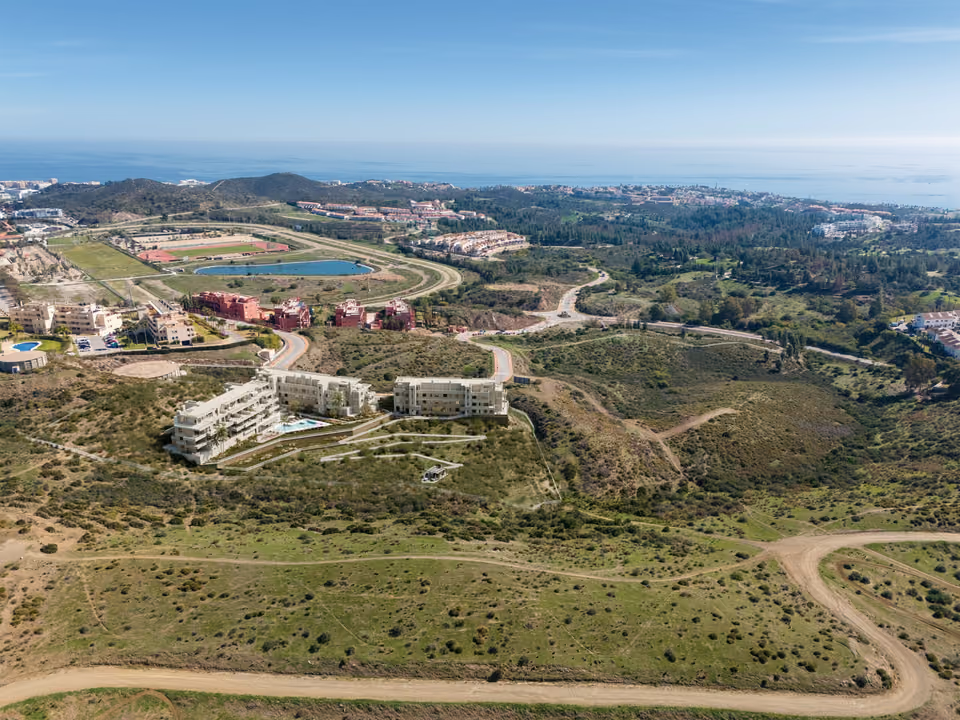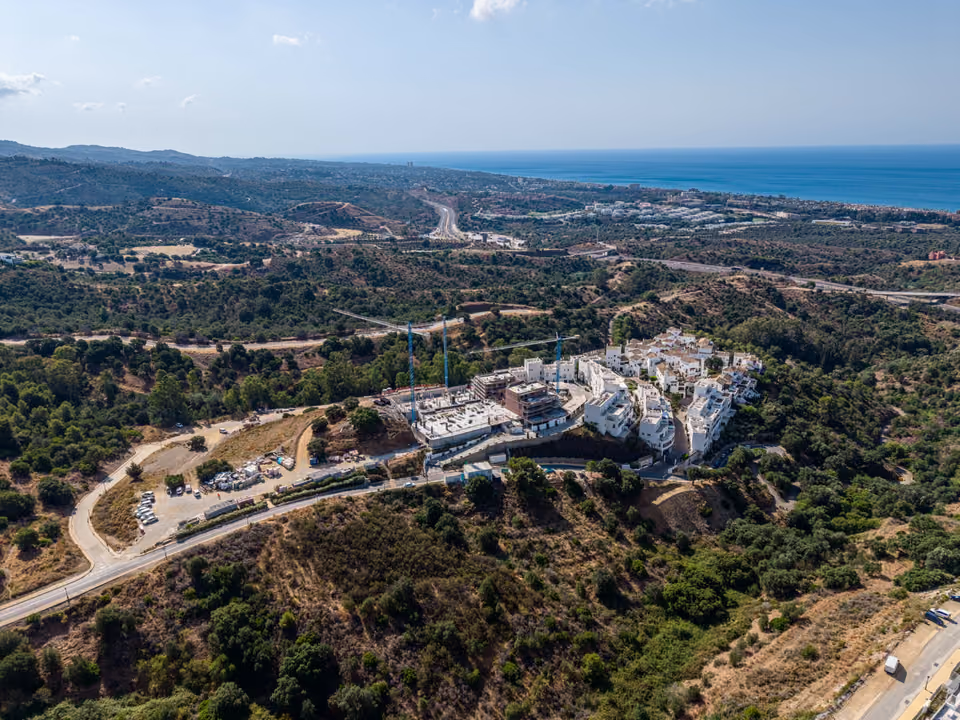
This guide covers the checks on a developer before you reserve a new home on the Costa del Sol: the building licence, the company behind the development, the developments it has already finished, and the contract it asks you to sign. Each one rests on a public record or on a document the developer has to show you. Most of it is routine, and a developer with its paperwork in order hands it over without fuss. The guarantee on the money you pay during the build is part of the same picture. It has a guide of its own, linked in its place below, so here it gets a paragraph rather than a section.
The name on the brochure and the name on the contract
The first thing to establish is which company is selling. A development is marketed under a brand, while the seller named in the contract is a company with a tax number and an entry at the Registro Mercantil, the companies register. The two do not always carry the same name, and it is the company in the contract whose records count.
Spanish consumer rules make that company easy to identify. Real Decreto 515/1989, article 4, requires anyone selling new homes to have available to the public its name, its address and its Registro Mercantil details. The same article adds the plans, a description of the home with its usable floor area, the materials used in the building, the Land Registry details of the property, and the full price with how it is paid. Article 5 adds a copy of the building licence, and article 9 entitles you to copies of all of it, at the seller’s cost, when you sign.
The company: the Registro Mercantil
The companies register is public. Its regulation, Real Decreto 1784/1996, says so in article 12, and the Colegio de Registradores says anyone can consult company information online, with the exact content of the accounts a company has deposited available at any hour of any day.
The essential details the register holds for each company are listed in article 387 of the regulation:
- its name and tax number, and its registered address
- its share capital
- the date it began trading, and what it was set up to do
- who its directors are, and its auditors where it has them
Companies deposit their annual accounts at the Registro Mercantil for their registered office, within a month of approving them (article 365), so a developer’s recent accounts can be read before you commit. Three questions are worth answering from the register and the accounts. How long has the company existed? Does it file its accounts? And is the company in the contract the one with the finished developments behind it, or a newer company formed for this one? A company formed for a single development is not a concern in itself. It simply means the group’s finished work, and the guarantee on your payments, carry more of the weight.
Two official publications complete the picture. The BORME, the companies register’s own gazette, is published by the BOE on working days and records the acts registered for each company: a change of name or address, new directors, a change of capital, a merger or a dissolution. And the Registro Público Concursal, which depends on the Ministry of Justice and is run by the Colegio de Registradores, publishes the court notices and decisions in insolvency proceedings. A clean result on both is the answer you want.
The building licence
Every new building in Andalucía needs a municipal licence before work starts. Andalucía’s planning law, Ley 7/2021, puts new buildings, and the division of a building into separate homes, under prior licence in article 137. Article 140 makes licences the town hall’s alone, granted after a technical report and a legal report on whether the project meets the planning rules.
Your lawyer reads the licence for four things:
- That it exists, for this project. Its number, its date and the development it covers, matching the plans you are shown.
- What it covers. The building described and the number of homes, which should match what is being sold.
- That it is still in time. Article 141 says a licence is granted for a fixed period to start and to finish the work. Where the licence sets none, the law sets one year to start and three years to finish, counted from the day after it was notified. The periods can be extended, before they run out, for no longer than the original period.
- Its date. The developer’s legal duty to guarantee the money you pay during the build runs from the day the building licence is granted, so the licence date and the guarantee are always checked together.
Two things can be seen without asking. Article 143 requires a board at the site showing the licence, the developer, the others taking part in the build and the building period. The same article says no advertising for a development may say anything that conflicts with the planning rules or could mislead buyers about them.
The Land Registry is the third place the licence shows up. Under article 28 of the national land law, a notary only signs a deed declaring a new building under construction once shown the licence and a certificate from a qualified professional that the building matches the licensed project, and the registrar asks for the same before recording it. So when the nota simple for the plot shows a declaration of new building under construction, a notary and a registrar have already seen the licence. The nota simple also shows who owns the land and whether a mortgage is registered against it. If a construction loan is secured on the plot, the consumer rules below say who bears its costs.
Some developments are sold before the licence is granted, and several of the developments selling before building starts on this site say so on their pages. That is a normal way to sell. It simply means the questions are when the licence is expected, how much is asked before it, and how that money is held.
The money you pay during the build
Every payment made to a developer before completion has to be guaranteed, by an insurance policy or a bank guarantee, and paid into a special account the developer can only draw on for the construction. Under the first additional provision of the building law, Ley 38/1999, the duty runs from the obtaining of the building licence, and the bank opening the account has to ask for the guarantee itself. What the guarantee must cover, what happens if the delivery date is missed and how a claim works are all set out in buying off-plan in Spain.
What it has finished before
The best evidence of how a developer will build is what it has built. There are three ways to see it.
Go and look. A finished development can be walked round: the common areas, the gardens and the pool, and how the building has weathered a few summers. The key-ready developments I list are finished ones that can be viewed now.
Look it up. A finished building is recorded at the Land Registry by a deed of completed new build. Article 28 of the national land law lets the notary and the registrar accept it only with the certificate that the work was finished as designed and the town hall’s authorisation for the building to be occupied, or proof that the declaration that replaces it has been lodged. In Andalucía that is now a responsible declaration, as the first occupation licence guide explains. A nota simple for a home in one of the developer’s earlier buildings shows whether all of that was done.
Ask the people who live there. The community of owners in a finished building, and the administrator who runs it, know how the developer dealt with the repairs in the first year. Article 17 of the building law makes the builder answer for defects in the finishes for one year, those who took part in the build answer for three years on the installations that make a home fit to live in and for ten years on the structure, and it makes the developer jointly liable with them to buyers. How a developer behaves inside those periods tells you a good deal. The checks on your own home when it is finished are in the checks before you take the keys.
The contract
After the reservation comes the private contract. On a development it is a purchase contract with the stage payments and the delivery date written in, or an arras contract. If it is an arras contract, the kind of arras decides whether either side can withdraw and what that costs, as the arras contract guide sets out.
Whatever form it takes, three rules of Spanish law apply to a developer selling a home to a consumer.
It has to be clear and complete. Article 10 of Real Decreto 515/1989 requires the contract to be written clearly and simply, with no reference to documents you have not been given beforehand or at the same time. It bars price increases for extras that are not genuine additional services you can accept or refuse as you choose, and any change to the works you ask for is to be written down with its effect on the price and the delivery date. The specification the contract refers to, the memoria de calidades, is covered in what a new build includes in 2026.
The developer’s own costs stay with the developer. Article 89 of the consumer protection law treats as unfair any clause in a home sale that makes the buyer pay for preparing the title, meaning the declaration of new building, the division into separate homes, or the construction mortgage and its division or cancellation. It also rules out obliging you to take over the developer’s mortgage or penalising you for not doing so, passing on taxes the developer owes, and charging you for connecting the home to the mains supplies when it has to be handed over ready to live in.
You choose the notary. The same article treats as unfair any clause that has you give up your right to choose the notary who authorises the deed.
Your own lawyer reads the contract against all of this before you sign, alongside the checks on the property itself: the nota simple, the licences, the community and the taxes, which are set out in the legal checks before you buy. On a new build the developer checks come first, because they decide whether the reservation is worth paying. The Spanish words on these documents are explained in the property glossary.
The checks at a glance
| Check | Where the answer comes from | A good answer |
|---|---|---|
| The building licence | The developer, the town hall, the nota simple | Granted, for this project and number of homes, within its deadlines |
| The company | The Registro Mercantil and the BORME | The seller in the contract, trading for some years and filing its accounts |
| Insolvency | The Registro Público Concursal | Nothing recorded |
| Finished work | Visits, nota simples, the owners | Buildings completed, registered and wearing well |
| The guarantee | The developer and its bank | A policy or bank guarantee for every payment, from the licence date |
| The contract | Your lawyer | Clear, complete and free of the developer’s own costs |
How I handle it
Before I suggest you reserve a new build, I ask the developer for the building licence and its date, the name of the company in the contract and the guarantee arrangements, and I look up the company’s register entry and its filed accounts. Where the developer has finished developments on this coast, I go and look at how they have worn. Your lawyer then reads the contract with all of that in hand.
If a developer is slow to produce any of it, I tell you, and we look at the next development on the list. Book a call and I can run these checks on a development you have already seen. Buying with me sets out how I work.
Common questions
How do I check a property developer in Spain?
Can I see a Spanish developer's accounts?
What should a developer show me before I reserve?
How can I check whether a Spanish developer is in insolvency proceedings?
Who pays the developer's own costs on a new build?
What this relates to